COVID-19 Community Quarantines in the Philippines
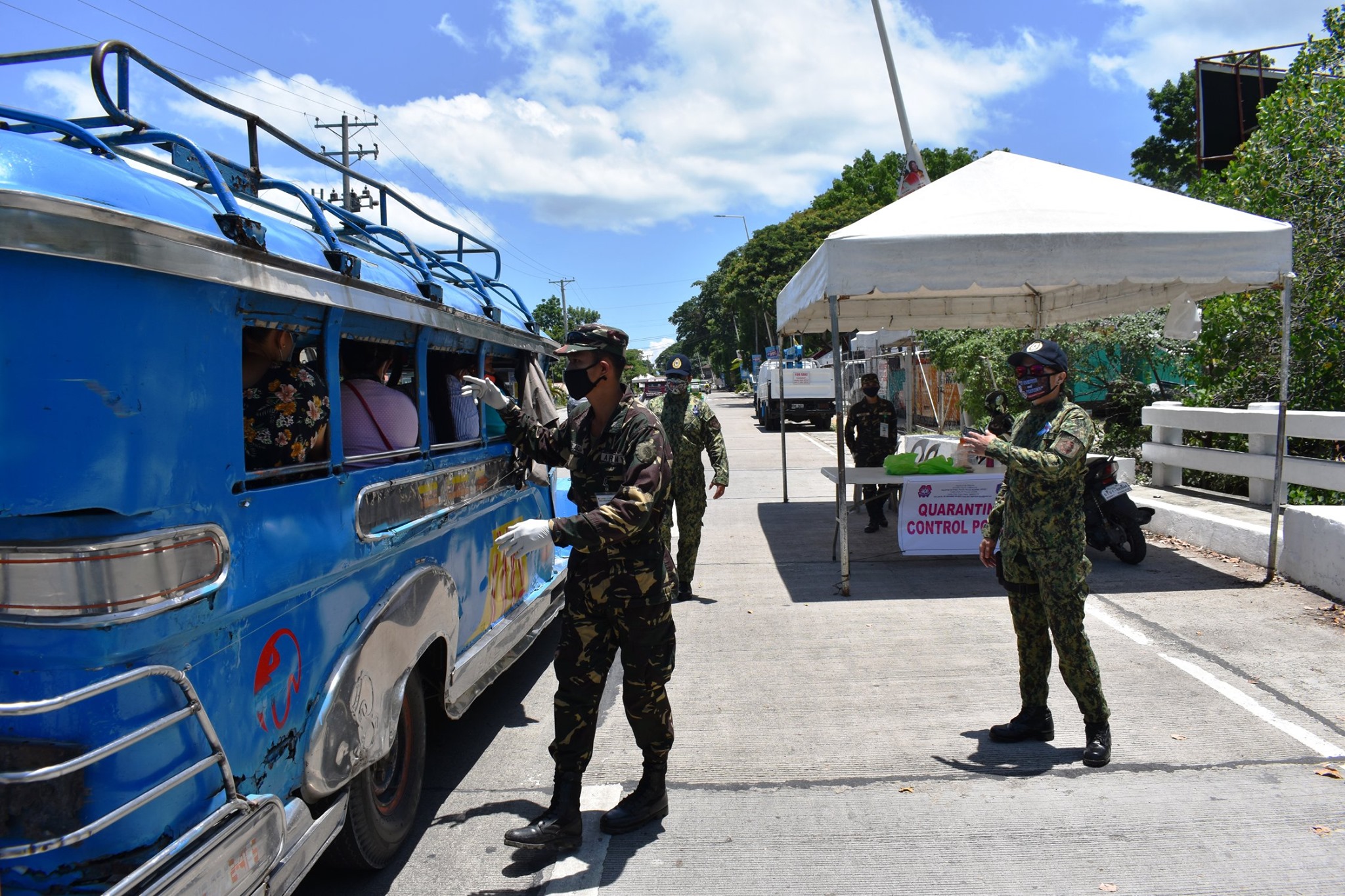
As a measure to limit the spread of coronavirus disease 2019 (COVID-19) in the Philippines, lockdowns, officially characterized as "community quarantines" by the government, of varying strictness were imposed in numerous parts of the country. The "enhanced community quarantine" (ECQ) is the strictest of such measures. The largest of these measures was the enhanced community quarantine in Luzon.
Overview
Given the rapidly increasing number of cases in the National Capital Region, Albay 2nd district representative Joey Salceda proposed a week-long lockdown of the region to prevent the disease from spreading nationwide. Salceda specifically proposed the closure of the Philippine expressway network and public transportation accessing the region, in addition to the suspension of classes and work. President Duterte initially rejected the proposal claiming it would "hamper the flow of basic commodities". Secretary Duque, however, raised the possibility of a lockdown on certain cities or towns if cases of community-based 12, President Duterte announced a partial lockdown covering Metro Manila, that began on March 15.
At one point during President Rodrigo Duterte's pronouncement about the Metro Manila "community quarantine," he said that "they are afraid to call it a lockdown, but it is a lockdown." This statement left many confused. His cabinet secretary, Karlo Nograles, later made it clear that the proper term is "community quarantine" and the President's comment means that the event "is like a lockdown". Nograles further said that the term "lockdown" can lead to different interpretations, while "community quarantine" is a technical term that medical authorities can give meaning, which does not create public fear.
When the "community quarantine" was applied to Luzon, Presidential Spokesperson Salvador Panelo, said that the Luzon-wide enhanced community quarantine (ECQ) is equivalent to an "absolute lockdown or total lockdown." Secretary Eduardo Año of the Department of Interior and Local Government (DILG) also said that "enhanced community quarantine" should be considered as a "total lockdown."
In addition, President Duterte advised local government units outside of the National Capital Region to implement a community quarantine in cases where, in a given level of local government, at least two COVID-19 cases are confirmed within a lower level of its jurisdiction; for example, a province-wide quarantine should be implemented if there are at least two COVID-19 cases confirmed within different cities or municipalities in the same province, while a city/municipality-wide quarantine should be implemented if there are at least two COVID-19 cases confirmed within different barangays in the same city or municipality. Local government units were also authorized to utilize their quick response funds upon declaration of a state of emergency.
The national government has given local government units under enhanced community quarantine in Visayas and Mindanao and relevant field offices of the Department of Health the power to lift or extend the lockdown period in their jurisdiction. The imposition of a "localized lockdown" involving measures at the barangay, sitio, and/or purok level instead of fully lifting ECQs has been proposed.
On April 6, the following localities were under enhanced community quarantine: all regions of Luzon, Western Visayas, Caraga Region, Zamboanga Peninsula, Samar, Biliran, Cebu, Negros Oriental, Camiguin, Bukidnon, Sultan Kudarat, Lanao del Sur, Lanao del Norte, Cotabato, South Cotabato, Tawi-Tawi, and the municipality of Catarman in Northern Samar.
On April 24, it was clarified that local government units can no longer impose quarantine measures without the consent of the Inter-Agency Task Force on Emerging Infectious Diseases (IATF-EID). Prior to that period, localities could impose such measures with coordination with the DILG. President Rodrigo Duterte issued Executive Order 112, extending enhanced community quarantine in select localities until May 15 and imposing a general community quarantine in the rest of the country, also overriding existing quarantine measures by local government units, starting May 1.
Classification
Enhanced community quarantine (ECQ)
Localities under an enhanced community quarantine (ECQ) are generally ordered to stay at home, with its residents restricted from traveling to other cities or barangays. Barangay governments can issue quarantine passes allowing residents to buy essential goods outside curfew hours and within the issuing barangays' jurisdiction. The Bayanihan to Heal as One Act also provides measures related to the ECQ, such as:
- Limitations on an all forms of transportation
- Work suspensions and the setting up of alternative working arrangements such as teleworking
- Ensuring the supply of food and medical products
- Measures against profiteering and hoarding of essential goods
- Provision allowing a 30-day grace period for loan and rental payments during the quarantine period
- Cancellation of mass gatherings
- Closure of non-essential businesses
- 24/7 opening of essential businesses and utilities in 100% operational capacity
General community quarantine (GCQ)
The general community quarantine (GCQ), which was introduced on May 1, is generally less stringent than ECQ. Public transportation is allowed at a reduced capacity and select businesses are allowed to operate at 50 to 100 percent of their regular capacity depending on their industry. Shopping malls are also allowed to operate, although only select stalls and stores are allowed to open.
A level under GCQ, is called a modified general community quarantine (MGCQ).
Other measures
There are types of quarantine or lockdown measures aside from the ECQ and GCQ. Additional measures have been imposed under an "extensive enhanced community quarantine" or "extreme enhanced community quarantine" (EECQ). An EECQ is generally stricter than an ECQ. Prior to the imposition of the enhanced community quarantine in Luzon, a more lenient measure, which includes a stay-at-home order and a curfew, was imposed in Metro Manila and was officially called a "community quarantine".
A "total lockdown" measure, distinct from an ECQ, has been considered, which would prohibit people from leaving their places of residence and mandate the closure of all public establishments. According to presidential spokesperson Harry Roque, this measure is considered as an option.
A "special concern lockdown" can be applied to only a portion of a barangay with a high concentration or clustering of active cases of COVID-19. It can be a road, a compound, or a block.
A classification of measures called "new normal", a level under MGCQ, was introduced sometime in June 2020, but has not yet been used. An area needs to be placed under MGCQ prior to the imposition of new normal measures.